
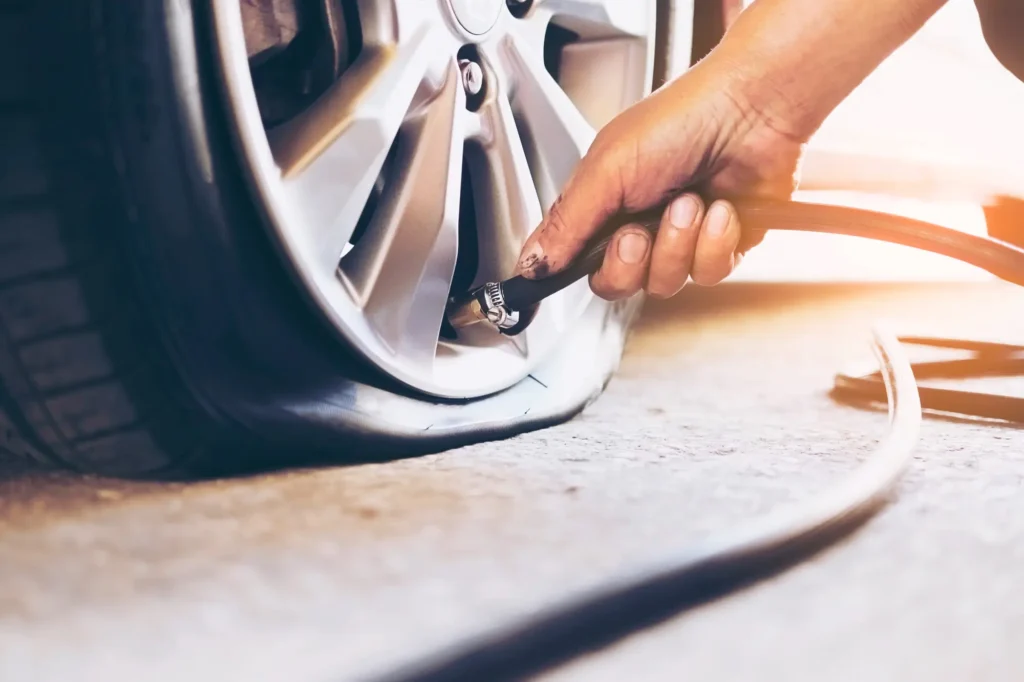
Quick Answer: Whether a puncture can be repaired depends on three things: where the damage is, how big it is, and what type of tyre you have. Under British Standard BSAU159, a puncture can only be safely repaired if it is in the central three-quarters of the tread, measures 6mm or less in diameter, and the tyre has sufficient structural integrity remaining. Sidewall damage, shoulder damage, run-flat tyres and any puncture over 6mm cannot be repaired — they require replacement. Mobile Tyres Co inspects, repairs or replaces tyres on-site across London and Hertfordshire, 24 hours a day, 7 days a week, with no callout fee.
You’ve found a nail in your tyre. Or the pressure light has come on. Or someone in a car park has pointed at your rear wheel with that specific look that means bad news. The first question every driver asks is the same: can this be repaired, or do I need a new tyre?
The honest answer is that many punctures can be repaired safely and legally — but the rules that determine which ones are strict, written into a British Standard, and frequently misunderstood. Some tyre shops will tell you a repair is not possible when it actually is. Others will offer a quick roadside fix that is not legally compliant and may fail without warning. Knowing the rules yourself puts you in control of the decision.
This guide explains exactly what British Standard BSAU159 says, what can and cannot be repaired under UK law, what to be cautious about, and how to get the right answer at your location — without needing to drive to a garage.
The Rule That Governs Every Tyre Repair in the UK: BSAU159
In the UK, all professional tyre puncture repairs are governed by British Standard BSAU159, which is also the shared standard of the British Tyre Manufacturers’ Association (BTMA). This is not an industry guideline or a recommendation — it is the legally recognised standard for safe minor tyre repairs, and any repair not carried out in compliance with it is considered unsafe and inadequate for road use.
BSAU159 defines everything: where in the tyre a repair can be made, the maximum size of damage that can be repaired, the materials and method required, and the conditions under which a repair must not be attempted. A tyre repaired correctly to BSAU159 standard offers the same performance as a sound tyre in terms of durability, load capacity and maximum speed rating.
For a puncture to be repairable under BSAU159, all of the following conditions must be met simultaneously:
- Location: The puncture must be within the central three-quarters of the tyre tread — the area known as the minor repair area. Damage outside this zone, including the shoulder and sidewall, cannot be repaired.
- Size: The diameter of the damaged area must not exceed 6mm. Anything larger cannot legally be repaired and requires tyre replacement.
- Tread depth: The tyre must have at least 1.6mm of tread remaining across the central three-quarters of the tyre. A tyre at or below the legal minimum cannot be repaired regardless of the puncture’s location or size.
- Structural integrity: The tyre must not have been driven on while flat or significantly underinflated, as this can cause internal damage that makes an otherwise repairable puncture unsafe to repair.
- No secondary damage: The tyre must not have sidewall separation, exposed cord, belt damage or other structural compromise beyond the puncture itself.
Important: If any single one of these conditions is not met, the tyre must be replaced. BSAU159 is a strict standard with no grey areas. A proper repair also requires the tyre to be removed from the wheel so the inside can be fully inspected — this cannot be done at the roadside without professional equipment.
What a Proper BSAU159 Repair Actually Involves
Understanding what a legitimate repair looks like helps you identify when you are not getting one — which matters more than most drivers realise.
A compliant BSAU159 repair follows these steps, in this order:
- The puncture is located and marked on the outside of the tyre
- The tyre is removed from the wheel — there is no way to inspect the inner liner without doing this
- The inner liner is inspected for creasing, powdered rubber, heat damage or run-flat stress indicators
- The damaged area is prepared using specialised equipment
- A combination patch-plug is vulcanised into place from the inside — not pushed in from outside
- The tyre is re-inflated, pressure tested, balanced and refitted with correct torque settings
The entire process takes approximately 20 to 30 minutes at your location. Mobile Tyres Co carries the equipment required to perform a fully compliant BSAU159 repair on-site at your home, workplace or roadside location across London and Hertfordshire including Berkhamsted, Chorleywood and Aylesbury.
If the Inner Inspection Fails: Sometimes the outside of a tyre looks repairable but the inner liner has been damaged by driving on a flat tyre — even briefly. If our technician finds inner damage during inspection, the tyre cannot be safely repaired and will need replacing. We will tell you immediately, credit the inspection fee against the replacement, and fit the new tyre in the same visit.
When a Puncture Cannot Be Repaired
This is where many drivers are either misled or simply not told the full picture. There are five situations where replacement is always required, with no exceptions.
1. Sidewall Damage
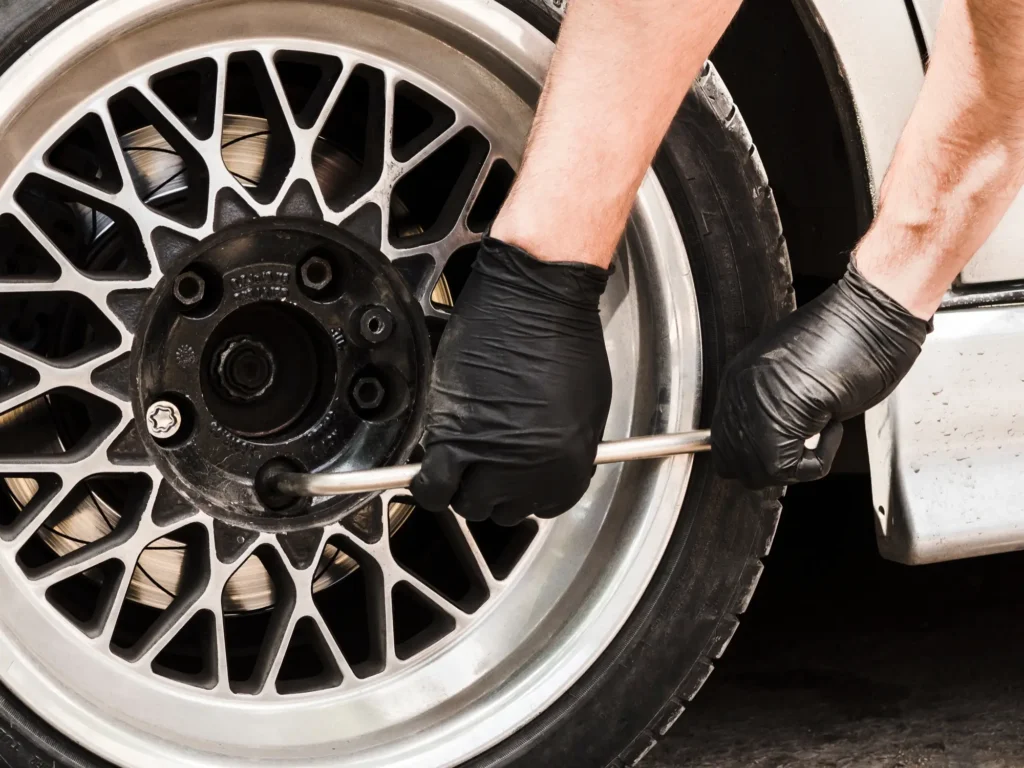
The sidewall is the part of the tyre between the tread and the bead — the curved section that faces outward when the tyre is fitted. It endures millions of flex cycles over the tyre’s life, continuously bending as the tyre rotates under load. A repair patch applied to the sidewall cannot withstand this repeated flexing and will eventually detach, often suddenly and at speed.
British Standard BSAU159 explicitly excludes the sidewall from the repairable zone. Any sidewall puncture, cut or bulge requires immediate tyre replacement — there is no safe repair option. A sidewall bulge, in particular, indicates that the internal structural cords have already failed. The tyre should not be driven on at all until replaced.
2. Shoulder Area Damage
The shoulder is the curved transition between the tread face and the sidewall. BSAU159 defines the repairable zone as the central three-quarters of the tread — the outer edges of the tread that approach the shoulder fall outside this zone. A puncture that sits even slightly too close to the shoulder edge cannot be repaired, regardless of its size.
3. Puncture Diameter Over 6mm
The maximum repairable damage diameter under BSAU159 is 6mm. A puncture caused by a nail or small screw will almost always be under this limit. A puncture caused by a larger bolt, shard of metal or road debris may exceed it. If the damage exceeds 6mm in diameter, replacement is the only legal option regardless of where the puncture is located.
4. Run-Flat Tyres
run-flat-tyres-london have reinforced sidewalls that allow the vehicle to continue driving for up to 50 miles at up to 50 mph after a complete pressure loss. This reinforcement is also what makes them impossible to repair. When a run-flat tyre has been driven on after a pressure loss, the internal stress and heat generated within the reinforced sidewall creates damage that cannot be identified visually or with standard inspection equipment.
Major tyre manufacturers including Pirelli, Hankook and Continental have confirmed that the requirements of BSAU159 cannot be satisfied when repairing a run-flat tyre. Any tyre shop offering to repair a run-flat puncture is not following the standard. Run-flat tyres must always be replaced after a puncture, not repaired.
Run-Flat Owners: If your vehicle’s TPMS warning light has come on and your car is fitted with run-flat tyres — common on BMW, Mini and Mercedes models — call us before driving further. We carry run-flat replacement stock for all common vehicle sizes across London and Hertfordshire.
5. Tread Below 1.6mm
A tyre at or below the UK legal minimum tread depth of 1.6mm cannot be repaired regardless of where the puncture is or how small it is. The tyre is already at the end of its legal road life and must be replaced. Attempting to repair a tyre at this depth and return it to service is not considered safe under BSAU159.
The Roadside Plug Repair: What You Need to Know
Plug-only roadside repairs — using a string plug or foam sealant pushed into the tyre from the outside without removing it from the wheel — are widely available as DIY kits and are also offered by some budget tyre operations. They are not a permanent repair and do not meet BSAU159
There are three significant problems with plug-only repairs:
- No inner inspection: The tyre is not removed from the wheel, so the inner liner cannot be checked for secondary damage. A tyre that has been driven flat, even briefly, may have internal damage that makes it unsafe to return to service regardless of how small the external puncture is.
- No vulcanised seal: A string plug pushed from the outside does not create the permanent, vulcanised bond that a proper patch-plug repair does. It can work loose, particularly at motorway speeds or in sustained wet conditions.
- It may void your insurance: A tyre returned to service after a non-compliant repair that subsequently fails could be considered a roadworthiness issue by your insurer in the event of a claim.
If you have had a plug-only repair done — at a petrol station, by a breakdown service, or using a DIY kit — the correct next step is to have the tyre professionally inspected and a proper BSAU159 repair carried out as soon as possible. Mobile Tyres Co can do this at your location.
Tyre Foam Sealant Kits: Many modern cars come with a foam sealant inflation kit rather than a spare wheel. These kits are designed for minor punctures as a temporary emergency measure only — they are not a permanent repair. They also coat the inside of the tyre, which can make a subsequent BSAU159 inspection and repair more difficult. Always tell your technician if a sealant kit has been used.
The Quick-Reference Decision Table
Not sure which category your puncture falls into? Use this table:
| Damage Type | Location | Size | Can It Be Repaired? |
| Nail or screw in tread | Central tread zone | Under 6mm | Yes – BSAU159 repair |
| Small object in tread | Central tread zone | 6mm or more | No – replacement required |
| Any damage – sidewall | Sidewall | Any size | No – immediate replacement |
| Any damage – shoulder | Tread shoulder edge | Any size | No – replacement required |
| Puncture on run-flat tyre | Any location | Any size | No – run-flat tyres cannot be repaired |
| Bulge or bubble visible | Sidewall | N/A | No – structural failure, replace immediately |
| Roadside plug-only repair | Central tread | Under 6mm | Temporary only – proper BSAU159 repair required |
| Tread below 1.6mm | Any | Any | No – replacement required regardless |
Cost: Repair vs Replacement in London and Hertfordshire
| Option | Typical Cost | When to Choose |
| BSAU159 puncture repair | From 20 to 35 pounds | Puncture in central tread, under 6mm, tyre structurally sound |
| Budget tyre replacement | From 60 to 90 pounds fitted | Unrepairable damage, worn tread, sidewall or shoulder damage |
| Mid-range replacement | From 90 to 130 pounds fitted | Same as above, want better wet grip and longer life |
| Premium replacement | From 130 to 220 pounds fitted | Premium vehicle, high mileage, run-flat requirement |
| Roadside plug kit | 5 to 15 pounds DIY | Emergency only – not a permanent fix, BSAU159 repair needed |
A legitimate BSAU159 puncture repair costs a fraction of a new tyre. If your puncture qualifies for repair, there is no reason to replace the tyre — any technician recommending replacement on a clearly repairable tyre without a valid technical reason should be questioned. Mobile Tyres Co will always advise honestly: if it can be repaired safely, we repair it.
How Mobile Tyres Co Handles Puncture Inspections and Repairs
When you call us with a suspected puncture, we ask about the tyre size, the type of vehicle and the nature of the damage. Based on what you describe, we advise whether a repair or replacement is more likely before we arrive — so you are not kept in the dark until we turn up.
Our technicians carry the equipment to perform a full BSAU159 inspection and repair on-site, including the ability to remove the tyre from the wheel, inspect the inner liner, and vulcanise a proper patch-plug repair at your location. We also carry a full range of replacement tyres in all common sizes for cases where the tyre cannot be repaired.
We cover all of London and surrounding areas including Hertfordshire, Buckinghamshire and Bedfordshire. Our three priority locations — Chorleywood, Berkhamsted and Aylesbury — are staffed and stocked to handle puncture repairs and replacements across the full HP4, WD3 and HP22 postcode areas, as well as the wider London network covering all boroughs. Service is available 24 hours a day, 7 days a week, with no callout fee and a fixed upfront price before anyone is dispatched.
A Slow Puncture Is Urgent: A slow puncture that still has air in it may feel driveable. But every mile on an underinflated tyre accelerates internal damage, turning a 30-pound repair into a 120-pound replacement. If you suspect a slow puncture, stop and call us. We can be with you in 30 to 60 minutes.
Frequently Asked Questions
Can a tyre puncture always be repaired?
No. Under British Standard BSAU159, a puncture can only be safely repaired if it is located in the central three-quarters of the tread, measures 6mm or less in diameter, and the tyre has not been structurally compromised. Sidewall punctures, shoulder damage, run-flat tyre punctures and any damage exceeding 6mm require replacement, not repair. A tyre with tread below 1.6mm also cannot be repaired regardless of the puncture’s size or location.
What is BSAU159 and why does it matter?
British Standard BSAU159 is the UK’s legally recognised standard for safe minor tyre repairs, shared by the British Tyre Manufacturers’ Association. It defines where a repair can be made, the maximum repairable damage size, the method and materials required, and the conditions under which a repair cannot be attempted. A repair carried out in compliance with BSAU159 is considered to offer the same performance as a sound tyre. A repair not in compliance with BSAU159 is considered inadequate for road use and may be unsafe.
Can a sidewall puncture be repaired?
No. The sidewall of a tyre undergoes millions of flex cycles over its life and cannot safely hold a repair patch. British Standard BSAU159 explicitly excludes the sidewall from the repairable zone. Any puncture, cut or bulge on the sidewall requires the tyre to be replaced immediately. A sidewall bulge is particularly urgent as it indicates the internal structural cords have already failed, creating a risk of sudden tyre collapse.
Can a run-flat tyre be repaired after a puncture?
No. Leading tyre manufacturers including Pirelli, Hankook and Continental have confirmed that the requirements of BSAU159 cannot be satisfied when repairing a run-flat tyre. The reinforced sidewall of a run-flat tyre, once subjected to the internal stress and heat of supporting the vehicle’s weight after pressure loss, cannot be reliably assessed for damage from the inside. Run-flat tyres must always be replaced after a puncture.
What is the difference between a proper repair and a roadside plug?
A proper BSAU159 repair requires the tyre to be removed from the wheel, the inner liner inspected, and a combination patch-plug vulcanised into place from inside. A roadside plug is inserted from the outside without removing the tyre from the wheel, with no inner inspection and no vulcanised seal. Plug-only repairs are a temporary emergency measure. They do not meet BSAU159, cannot guarantee the tyre’s internal integrity, and should be followed by a proper inspection and repair as soon as possible.
How quickly can Mobile Tyres Co reach me for a puncture repair in London?
Mobile Tyres Co aims to reach customers across London and surrounding areas including Hertfordshire, Buckinghamshire and Bedfordshire within 30 to 60 minutes of a call. The service operates 24 hours a day, 7 days a week. There is no callout fee and no out-of-hours surcharge. Call 07982 378 899 at any hour.
Is mobile puncture repair as thorough as a garage repair?
Yes. Mobile Tyres Co carries the same equipment required for a proper BSAU159 repair that a workshop garage would use, including the ability to remove the tyre from the wheel and inspect the inner liner on-site. The repair process is identical to a garage visit — the only difference is that it takes place at your location rather than in a workshop. A compliant BSAU159 repair, whether done in a garage or at your roadside, offers the same performance as a sound tyre.
My pressure warning light came on but the tyre looks fine. What is happening?
This is the classic sign of a slow puncture — a small nail or a slightly leaking valve stem that loses pressure gradually rather than all at once. The tyre may appear normal at a glance but will be measurably underinflated. Do not ignore it. Driving on a consistently underinflated tyre causes internal structural damage that can turn a repairable slow puncture into a required replacement. Call us to inspect, identify the cause and repair or replace as needed.
The Bottom Line
A puncture does not automatically mean a new tyre. Under BSAU159, a significant proportion of punctures — particularly nails and small screws in the central tread area — can be safely and permanently repaired for a fraction of the cost of replacement. The key is knowing the rules, insisting on a proper inspection, and not accepting a plug-only repair as a permanent solution.
If you have a puncture right now — a flat tyre, a pressure warning light or a nail you’ve just spotted in the tread — call Mobile Tyres Co. We will advise honestly over the phone about whether repair or replacement is likely, arrive at your location across London, Hertfordshire, Berkhamsted, Chorleywood or Aylesbury within 30 to 60 minutes, and carry out whichever solution is correct for your tyre on the spot.
Mobile Tyres Co: 07982 378 899 | 24/7 Puncture Repair Across London and Hertfordshire | mobile-tyres.co