
| QUICK ANSWER – What to Do After Pothole Tyre Damage |
| 1. Pull over safely and turn on your hazard lights immediately. |
| 2. Do NOT drive on – a damaged tyre can cause a blowout or further suspension damage. |
| 3. Check the tyre for bulges, cracks, or loss of pressure. |
| 4. Call Mobile-Tyres.co for a mobile tyre repair – we reach you in 30 minutes. |
| 5. Photograph the pothole and your damage for a council claim. |
| 6. Report the pothole to your local council or TfL to start your claim. |
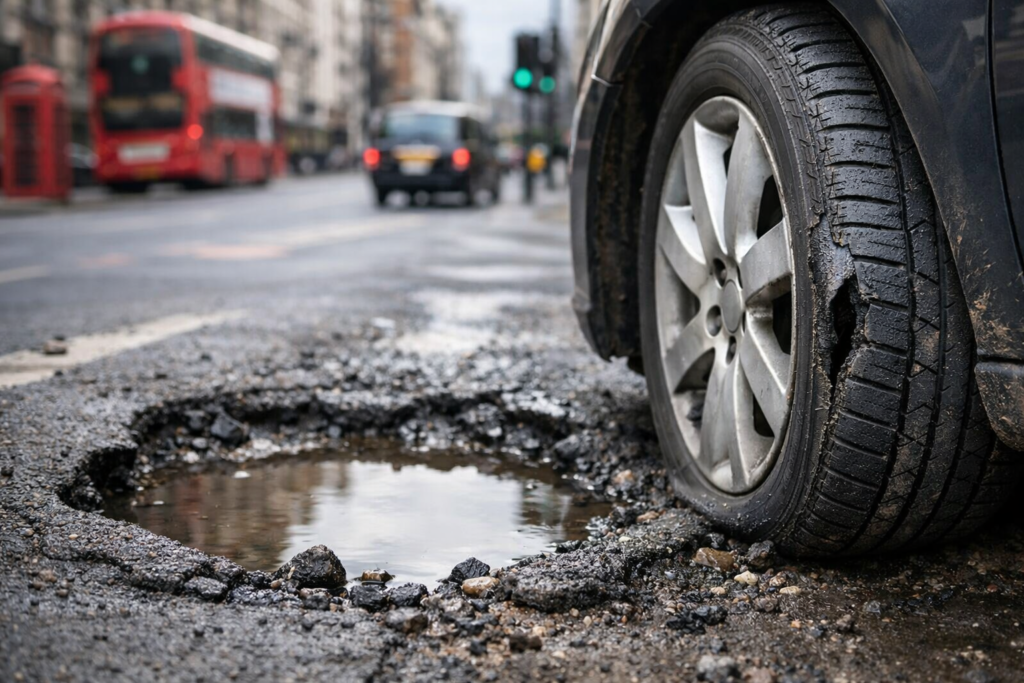
Pothole Damage: You’re driving along the A406 North Circular, a side street in Hackney, or a back road near Luton, and it happens – a sharp jolt, a loud bang, and your steering suddenly feels wrong. You’ve hit a pothole, and your tyre has taken the hit.
You are not alone. In 2026, pothole season across the UK has arrived earlier and with greater severity than in previous years. Freeze-thaw cycles over the winter months have torn up road surfaces from London’s East End to the estates of Aylesbury and Milton Keynes. TfL road conditions reports and council maintenance backlogs confirm it: UK roads are in a poor state, and drivers are paying the price through impact damage, surface damage, fractured tyres, and costly wheel alignment repairs.
This guide tells you exactly what to do after hitting a pothole – step by step. You will learn how to check for tyre damage, whether you can claim compensation from your council, and how Mobile-Tyres.co can have a qualified mobile tyre fitter with you in 30 minutes, wherever you are in London, Hertfordshire, Bedfordshire, or Buckinghamshire.
Why 2026 Is the Worst Pothole Season in Years
The science behind pothole season is straightforward. Water seeps into existing cracks in the road surface. When temperatures drop, that water freezes and expands, forcing the cracks wider. When it thaws, the weakened asphalt collapses – creating the potholes that are tearing tyres apart across the UK right now.
The 2025-26 winter brought multiple freeze-thaw cycles to the South East, the Midlands, and the North. Local authorities are reporting a surge in council pothole reports and road maintenance requests. Streets in London postcodes including E10, E11, N17, NW2, SE4, and W12 have seen significant surface damage. The same pattern is visible on roads into Watford, Hemel Hempstead, St Albans, and Luton.
The financial toll is significant. UK drivers collectively spend hundreds of millions of pounds each year on pothole-related vehicle repairs – tyres, wheels, suspension components, and front-end alignment corrections. Understanding your rights and acting fast after an impact can save you serious money.
Which London Roads Are Worst Affected?
Based on TfL road conditions data and council reports, the following routes and areas are seeing the highest levels of impact damage and pothole-related tyre incidents in early 2026:
- A406 North Circular – heavy traffic accelerates surface deterioration
- A10 corridor through Hackney, Tottenham, and Enfield
- B roads and residential streets in East London (E postcodes)
- Roads in and around Luton town centre
- A41 between Watford and Hemel Hempstead
- Rural B roads in Buckinghamshire between Aylesbury and High Wycombe
- A5 through Milton Keynes and into Dunstable
My Tyre Burst After Hitting a Pothole – What Do I Do?
If your tyre has blown out or gone flat after hitting a pothole, stay calm. A pothole blowout in London traffic or on a busy A-road is frightening, but the right response keeps you and other drivers safe.
Step 1 – Pull Over Safely
Grip the steering wheel firmly with both hands. Do not brake suddenly. Ease off the accelerator and steer gradually towards the nearest safe stopping point – a layby, side street, or wide pavement edge. Turn on your hazard lights immediately.
Step 2 – Do Not Drive On a Damaged Tyre
This is critical. Driving on a flat or structurally compromised tyre – even for 100 metres – can destroy the tyre completely, damage the wheel rim, and compromise your suspension. The repair cost will increase significantly if you keep moving. Stop where it is safe to do so and call for help.
Step 3 – Make the Scene Safe
If you are on a motorway or dual carriageway, exit the vehicle from the passenger side where possible. Move behind the barrier or as far from moving traffic as you can. Switch on your hazard warning lights and, if you carry one, place an emergency warning triangle at least 45 metres behind your vehicle. Do not stand between your car and moving traffic.
Step 4 – Call Mobile-Tyres.co
Get mobile tyre repair after pothole damage in 30 minutes. Our qualified technicians cover all London postcodes, Watford, St Albans, Hemel Hempstead, Luton, Aylesbury, and Milton Keynes. We carry a full range of replacement tyres and can fit them at your location – roadside, at home, or at your office. Cars, vans, and commercial vehicles.
| Tyre blown after a pothole? Call Mobile-Tyres.co now – 30-minute response across London, Hertfordshire, Bedfordshire & Buckinghamshire |
How to Check Tyre Damage After Hitting a Pothole
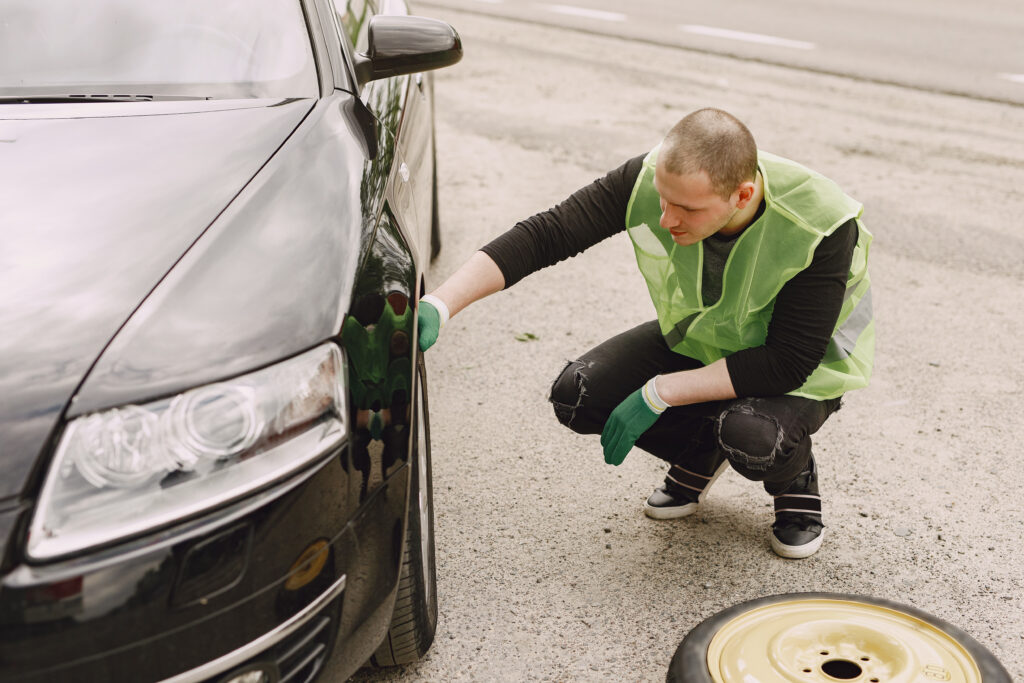
Not all pothole damage is immediately obvious. Some impact damage only becomes apparent after driving a short distance. Here is a systematic check you can carry out at the roadside.
Visual Inspection – What to Look For
- Bulge in tyre sidewall – a bulge is a structural failure caused by impact damage. The tyre is no longer safe and must be replaced immediately.
- Sidewall cracks or cuts – impact with a pothole edge can slice or split the sidewall rubber, compromising structural integrity.
- Tread damage – look for cuts, chunks missing from the tread, or exposed cord/wire visible through the rubber.
- Visible loss of pressure – if the tyre looks noticeably flatter than normal, it has lost air. Do not drive on it.
- Wheel rim damage – check the alloy or steel rim for bends, cracks, or dents. A damaged rim cannot hold air pressure safely.
Signs of Damage That Require Driving Assessment
If the tyre appears visually intact but you still drove over a significant pothole, monitor carefully for these warning signs:
- Steering pulling to one side (wheel alignment after pothole is a common issue)
- Vibration through the steering wheel at speed
- Vehicle handling feels unstable or loose
- TPMS warning light on your dashboard has illuminated
- Unusual noise from the wheel area when driving
Important: If you notice any of these signs, do not continue driving at normal speed. These symptoms can indicate hidden sidewall damage, a slow puncture, or a bent rim – all of which can lead to sudden tyre failure. Call Mobile-Tyres.co for a professional damage assessment.
Pothole Damaged Rim and Tyre – Understanding the Full Repair Cost
A pothole strike does not always limit its damage to the tyre. Impact damage can affect multiple components simultaneously, and understanding the cost estimates involved helps you make an informed decision about repairs.
| Damage Type | Typical Repair Cost (2026) |
| Tyre replacement (standard) | £80 – £160 fitted |
| Tyre replacement (run-flat) | £140 – £280 fitted |
| Wheel rim repair (alloy) | £60 – £150 per wheel |
| Wheel rim replacement (alloy) | £150 – £400 per wheel |
| Wheel alignment correction | £40 – £80 (2-wheel) |
| Suspension inspection + repair | £100 – £500+ |
| TPMS sensor replacement | £50 – £120 per sensor |
| Full damage assessment | Included with Mobile-Tyres.co call-out |
Mobile tyre repair after pothole damage from Mobile-Tyres.co covers tyre replacement and fitting on-site. Our technicians can also assess rim damage and advise on suspension issues, helping you understand the full scope of repairs needed before costs escalate.
Can I Claim for Pothole Tyre Damage UK?
Yes – you can claim for pothole tyre damage in the UK. Councils and Highways England have a legal duty to maintain roads in a reasonable condition under the Highways Act 1980. If a road defect causes damage to your vehicle and the authority was aware of it (or should have been), you may be entitled to compensation.
Claims are not guaranteed, and councils often rely on a ‘Section 58 defence’ – arguing they had adequate maintenance schedules in place. However, thousands of successful claims are made every year, and having the right evidence makes all the difference.
What Evidence Do You Need for a Pothole Claim?
Gather this evidence as soon as it is safe to do so:
- Photograph the pothole clearly, showing its size and depth. Include a coin, ruler, or your hand for scale.
- Photograph your tyre damage and any rim damage from multiple angles.
- Note the exact location – road name, nearest junction, postcode.
- Record the date, time, and weather conditions.
- Get a repair invoice or quote from Mobile-Tyres.co as documentary evidence of the cost.
- Check whether the pothole had already been reported using the council’s online report system.
- Note any witnesses, dashcam footage, or nearby CCTV.
How to Submit a Pothole Damage Claim Form in the UK
The claims process depends on which road authority is responsible:
- London roads (TfL-managed) – report and claim via the TfL website. This covers red routes and Transport for London-managed roads.
- London borough roads – contact your local borough council directly. Each London borough has a road defect reporting and claims system.
- Motorways and major A-roads (National Highways) – claim via the National Highways website or by telephone.
- Local authority roads outside London – Luton Borough Council, Hertfordshire County Council, Buckinghamshire Council, and Bedfordshire councils all have online pothole report systems.
Complete a pothole damage claim form as soon as possible after the incident. There is generally a three-year limitation period for vehicle damage claims, but councils process recent claims more favourably. The sooner you act, the better.
What Happens If Your Claim Is Rejected?
If a council rejects your initial claim, you have further options. You can request a review of their decision, escalate to the Local Government Ombudsman, or pursue a claim through the small claims court for amounts under £10,000. Many drivers who pursue rejected claims do eventually receive at least partial reimbursement – especially where evidence is strong.
Why Mobile Tyre Fitting Is the Fastest Solution After a Pothole Blowout
When a tyre fails in London traffic – or on an A-road outside Watford or Aylesbury – the last thing you want is to wait hours for recovery, get towed to a garage, and spend an afternoon in a waiting room. Mobile tyre fitting brings the solution to you.
Mobile-Tyres.co vs Traditional Breakdown Recovery
| Mobile-Tyres.co | Traditional Breakdown Recovery |
| 30-minute average response | 45-120 minute average wait |
| Tyre fitted at your location | Tow to garage + further wait |
| All vehicle types – cars, vans, HGVs | Varies by provider |
| Emergency and scheduled service | Emergency only (most plans) |
| Transparent pricing, no hidden fees | Additional charges common |
| Full range of tyre brands on board | Limited stock on recovery vehicles |
| TPMS reset and valve service available | Rarely included |
Our mobile tyre fitters serve all London postcodes including E10, E11, N, NW, W, and SE areas, as well as Watford, Hertfordshire, Luton, Dunstable, Bedford, Aylesbury, Milton Keynes, High Wycombe, and surrounding areas. We carry performance tyres, run-flat tyres, commercial vehicle tyres, and standard passenger car tyres.
| Need a mobile tyre fitter after pothole damage near you? We cover London, Hertfordshire, Bedfordshire, and Buckinghamshire. Cars, vans, and commercial fleets. Emergency and scheduled – 24 hours a day. Call Mobile-Tyres.co for a 30-minute response. |
Preventing Pothole Damage – Driving Safety Tips for UK Roads in 2026
While you cannot avoid every pothole on UK roads, you can significantly reduce your risk of tyre damage and suspension issues with these practical driving safety measures.
- Maintain correct tyre pressure – underinflated tyres are far more vulnerable to impact damage from potholes. Check pressure weekly, especially in cold weather.
- Increase following distance – more space ahead gives you time to spot and avoid potholes before they are hidden by the vehicle in front.
- Reduce speed on deteriorated roads – lower speeds mean lower impact forces. Pavement condition on residential streets in E and N London postcodes is particularly variable.
- Avoid sudden swerving – swerving sharply to avoid a pothole can cause you to collide with another vehicle or lose control. Where a pothole is unavoidable, slow down and drive straight through.
- Grip the wheel firmly – both hands on the wheel when you expect rough road conditions helps maintain control through impact.
- Consider tyre quality – premium tyre brands with reinforced sidewalls offer better impact resistance. Ask our technicians for advice on the best options for London driving.
Fleet Operators – Pothole Damage and Preventive Measures
For businesses operating vehicle fleets in London and across the South East, pothole season represents a real budget risk. Front-end alignment issues, repeated tyre replacements, and suspension damage accumulate quickly across a fleet.
Mobile-Tyres.co offers scheduled fleet maintenance programmes that include regular tyre inspections, pressure checks, and on-site fitting – minimising downtime and keeping your vehicles on the road. Contact us to discuss a fleet maintenance schedule tailored to your operation.
Summary – Your Pothole Damage Action Plan
Pothole season 2026 is hitting UK roads hard. From the North Circular in London to the B-roads of Buckinghamshire, impact damage, fractured tyres, and suspension issues are an everyday reality for drivers right now.
The most important things to remember are these: pull over safely, do not drive on a damaged tyre, document everything for a council claim, and call Mobile-Tyres.co for a 30-minute mobile tyre repair wherever you are.
You may be entitled to compensation from your local council or TfL. You deserve a fast, professional repair without the wait. And you need a tyre fitter you can trust – one who comes to you, fixes the problem on the spot, and gets you back on the road quickly.
Frequently Asked Questions
How long do I have to make a pothole damage claim in the UK?
You generally have three years from the date of the incident to make a claim under the Limitation Act 1980. However, claims submitted promptly – ideally within days or weeks of the incident – are processed more favourably by councils. Evidence is also fresher, which strengthens your case.
Is a bulge in my tyre dangerous after hitting a pothole?
Yes. A bulge in the tyre sidewall indicates that the internal structure has been compromised by impact damage. The tyre can fail without warning at any time – particularly at speed. Do not drive on a tyre with a visible bulge. Call Mobile-Tyres.co for an emergency replacement.
Will my car insurance cover pothole tyre damage?
It depends on your policy. Comprehensive auto insurance may cover pothole damage, but making a claim will likely affect your no-claims bonus. In many cases it is more cost-effective to claim directly from the council responsible for the road, especially if the damage is significant. Keep your repair invoice from Mobile-Tyres.co as evidence for either route.
How quickly can Mobile-Tyres.co reach me in London?
Our average response time across our service areas is 30 minutes. We cover all London postcodes (E, N, NW, W, SE) as well as Watford, Hemel Hempstead, St Albans, Luton, Dunstable, Bedford, Aylesbury, Milton Keynes, and High Wycombe. We operate 24 hours a day for emergency callouts.
Do I need to report the pothole even if I do not plan to claim?
Yes. Reporting a pothole to your local council or TfL helps protect other road users and creates a public record of the defect. Once a pothole is officially reported, the council has a duty to inspect and repair it within a reasonable timeframe. Your report could prevent another driver from suffering the same damage.