
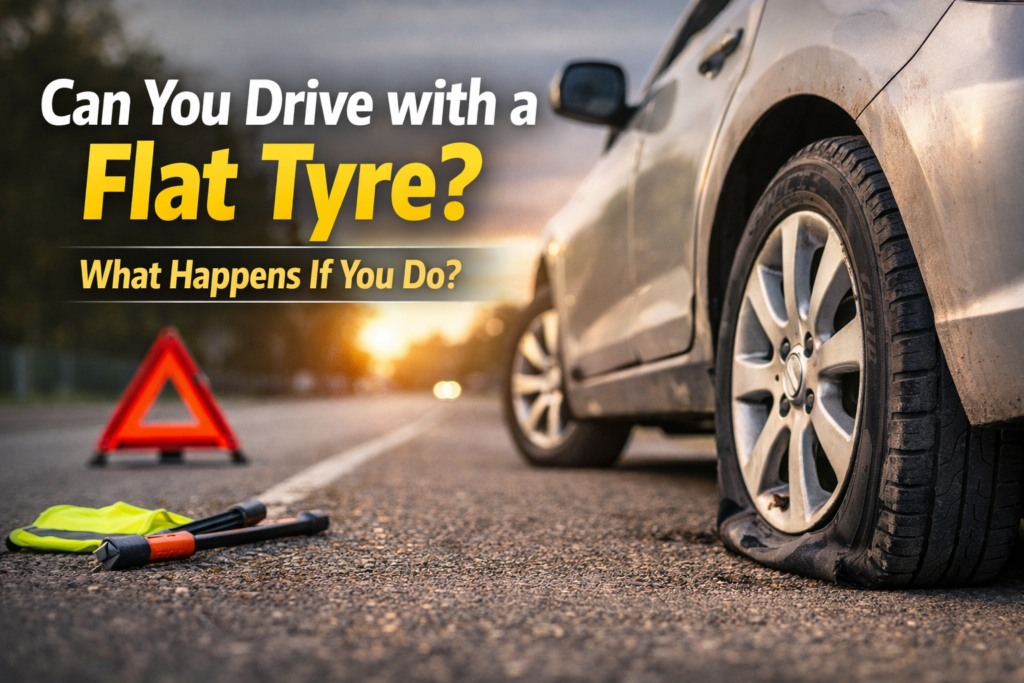
Drive with a Flat Tyre You’ve just noticed your tyre is flat — or rapidly losing air — and you’re weighing up whether you can limp it to the nearest garage. Maybe you’re already late. Maybe you’re only a few miles from home. Maybe you’re thinking, “It can’t be that bad, can it?”
Here’s the uncomfortable truth: driving on a flat tyre, even for a short distance, can cause serious damage to your car. We’re talking bent rims, wrecked wheel bearings, potential loss of control, and repair bills that make a new tyre look like pocket change.
Let’s talk about what actually happens when you drive on a flat, how far you might realistically get, and what you should do instead.
What Happens When You Drive on a Flat Tyre
A tyre isn’t just rubber. It’s a carefully designed structure that supports the weight of your car, absorbs road impact, and keeps your wheels turning smoothly. When it loses air, that entire system collapses.
Here’s what goes wrong:
The rim makes contact with the road
Your alloy or steel wheel is now grinding directly against tarmac. Rims aren’t designed for this. They bend, crack, or distort — sometimes beyond repair.
The tyre sidewall shreds
Even if there’s some air left, the sidewall flexes and overheats under the car’s weight. Within a few hundred metres, the rubber can tear apart completely.
Wheel alignment goes off
Driving on a flat puts uneven stress through your suspension. You might not notice immediately, but your steering geometry can shift, leading to uneven tyre wear and handling issues down the line.
Braking becomes unpredictable
A deflated tyre doesn’t grip the road properly. Your stopping distance increases, and in wet conditions, you’re far more likely to skid or lose control.
Your TPMS sensor may get damaged
Most modern cars have tyre pressure monitoring sensors fitted inside the wheel. If the tyre collapses completely, the sensor can snap off or get crushed — and replacements aren’t cheap.
How Far Can You Actually Drive on a Flat Tyre?
The short answer: not far, and not safely.
If you’re crawling along at 10–15 mph on a completely flat tyre, you might cover a few hundred metres before the damage becomes severe. But even that’s pushing it.
At normal speeds — say, 30 mph or above — the tyre will disintegrate in less than a mile. The rim will likely be damaged within the first few hundred yards. If you’re on a motorway when it happens, the risks multiply. High speed, heavy traffic, and a collapsing tyre is a recipe for loss of control.
Some people assume that if the tyre still has some air, it’s safe enough to keep going. The problem is that a slow puncture becomes a fast one under load. What feels like “a bit soft” at standstill can turn into a blowout under braking or cornering.
There’s no safe distance. If your tyre is flat, driving on it — even a short distance — is a gamble.
What About Run-Flat Tyres?
Run-flat tyres are designed to keep going even after a puncture, but they’re not invincible.
Most run-flats allow you to drive up to 50 miles at a maximum of 50 mph after losing pressure. That’s enough to get you home or to a garage — but only if you follow the limits. Go faster, drive further, or ignore the TPMS warning light, and you’ll still wreck the tyre and potentially the wheel.
Run-flats also need to be replaced after a puncture, even if they look fine. The internal structure weakens once it’s been driven on while deflated, and repairing them isn’t usually safe or recommended.
If you don’t have run-flats (and most cars don’t), the advice is simple: don’t drive on the flat.
The Real Cost of “Just Getting Home”
Let’s say you ignore the flat and decide to drive the three miles home anyway. Here’s what that decision might cost you:
- New tyre: £60–£120
- Damaged alloy wheel: £150–£300 (sometimes more for premium finishes)
- TPMS sensor replacement: £40–£80
- Potential suspension or alignment damage: £100+
Suddenly, a problem that could’ve been solved with a single tyre replacement has turned into a £400+ repair bill.
And that’s assuming you make it home without losing control or causing an accident.
What You Should Do Instead
If you discover a flat tyre, here’s the safest approach:
Pull over as soon as it’s safe
If you’re on a motorway, get onto the hard shoulder or into an emergency refuge area. On a normal road, find a safe, flat spot away from traffic.
Don’t attempt to drive to a garage
Even if it’s close. The damage happens faster than you think.
Check if you have a spare
If you’ve got a full-size spare and feel confident changing it, that’s an option — but make sure you’re in a safe location. If you’re on a busy road or motorway, it’s often safer to wait for professional help.
Call for mobile tyre fitting
This is where mobile services make the most sense. Rather than risking your car (and your safety) trying to limp somewhere, a fitter can come to you — whether you’re on your drive, in a work car park, or stuck on the roadside.
The tyre gets replaced on the spot. You don’t need to move the car. And you avoid the cascade of damage that comes from driving on a flat.
Why Mobile Tyre Fitting Makes Sense in This Situation

When you’ve got a flat, your instinct is to solve the problem as quickly as possible. But “quick” doesn’t mean driving on it.
Mobile tyre fitting removes the dilemma entirely. You stay where you are. The equipment and the replacement tyre come to you. Within 30–60 minutes of the call, the job’s done and you’re back on the road safely.
It’s especially useful if:
- You’re not confident changing a tyre yourself
- You don’t have a spare (many modern cars don’t)
- You’re in an awkward or unsafe location
- The flat happened outside normal garage hours
For drivers around London, Hertfordshire, Buckinghamshire, and surrounding areas, mobile services are often faster than organising recovery and waiting for a garage to open.
Can You Repair a Tyre After Driving on It Flat?
In most cases, no.
If the tyre has been driven on while deflated — even for a short distance — the internal structure is likely compromised. The sidewall may have flexed beyond its limits, the belt layers inside can separate, and the bead (where the tyre sits on the rim) may have been damaged.
A reputable fitter won’t repair a tyre that’s been driven flat, because it’s a safety risk. Even if it holds air, the structural integrity is gone.
This is another reason not to take the chance. Driving on a flat doesn’t just risk the wheel — it usually means replacing the tyre regardless, so you’ve gained nothing and potentially damaged a lot more.
What If You’re on the Motorway?
Motorway flats are particularly dangerous, and the rules are clear:
- Get to a place of safety — hard shoulder or emergency area
- Exit the vehicle from the passenger side if it’s safe to do so
- Stand behind the barrier, not next to the car
- Call for help — either breakdown recovery or mobile tyre assistance
Do not attempt to change the tyre yourself on a live motorway. The risk of being hit by passing traffic is too high, even on the hard shoulder. On smart motorways without a hard shoulder, it’s even more critical to reach an emergency refuge area.
If you can’t get off the carriageway safely, call 999 and stay in the car with your seatbelt on until help arrives.
Final Thoughts
Driving on a flat tyre is one of those “I’ll just risk it” decisions that almost never ends well. The damage happens fast, the repair costs spiral, and the safety risks are real.
If you’re faced with a flat, the smartest move is to stop, assess the situation, and get proper help. Whether that’s fitting a spare yourself in a safe location or calling a mobile tyre fitter to come to you, it’s always better than gambling with your wheels, your car, and your safety.
A new tyre costs far less than a new rim, a tow truck, or an insurance claim. And your life is worth more than saving twenty minutes.